13 February 2020
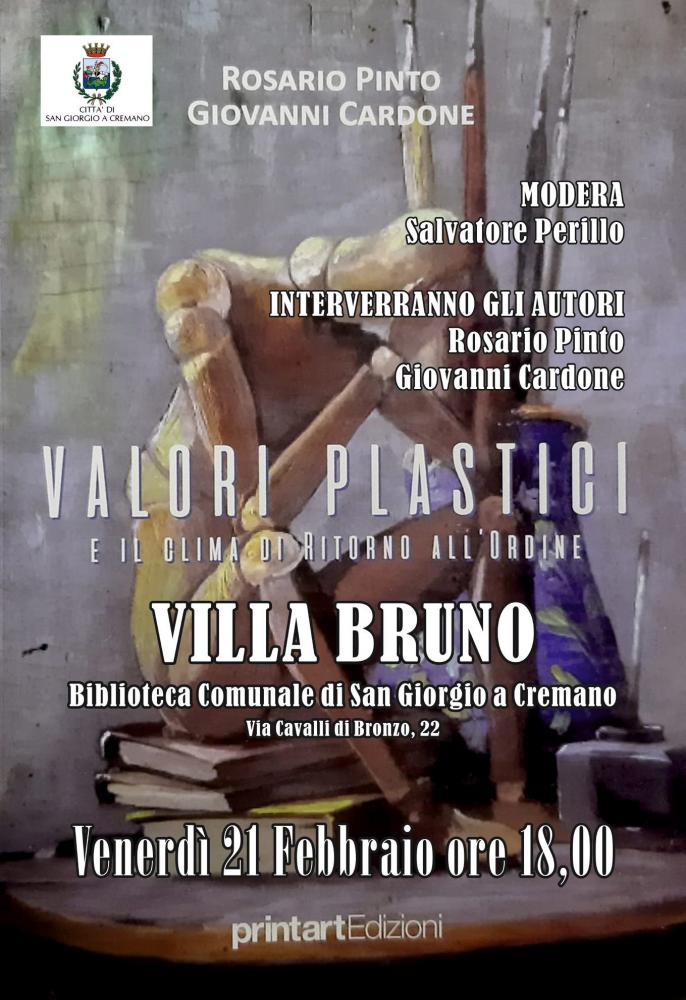
On Friday 21 February at 6.00 pm at the Villa Bruno - Municipal Library of San Giorgio a Cremano the book by Rosario Pinto and Giovanni Cardone Valori Plastici and the Climate of Return to the Order published by Printart Nocera Superiore - Salerno will be presented. Moderator Salvatore Perillo The authors Rosario Pinto and Giovanni Cardone will speak. As Rosario Pinto and Giovanni Cardone say: With the end of the First World War, a period of reflection opens on what had been the climate of the avant-garde of the early twentieth century and the opportunity for a recovery of values that characterized the period was considered previous one. This does not mean that a return to the past is suggested, but rather a 'return to order', where with this phrase it can be pointed out the need for a regulatory prescription that constitutes a valid legal orientation. Therefore, the return to order is a cultural climate that pervades the whole of Europe and finds, in particular in Italy, a decisive junction with the birth of the magazine "Valori Plastici", around which a core of intellectuals and of artists who will direct the cultural course of the decades between the two world wars. We have intended to reflect on these things, considering the significance of the political and social history of these crucial years, highlighting the role of isolated groups and personalities of artists, reasoning on the incidence of magazines and finally enlightening unpublished or little known aspects of artistic culture .
Biography of Rosario Pinto
Historian and art critic, born in Naples in 1950, he studied in the Neapolitan University of 'Federico II' and in the Institute of Art History directed by Ferdinando Bologna. He had training experiences in Germany in Heidelberg. He has been a professor at state university and academic institutions, currently a teacher at the School of Advanced Training of Art and Theology of the Pontifical Faculty of Theology of Southern Italy, is a journalist, founder and former director of public art galleries of Contemporary Art, Director of the Institute of Studies on Abstractionism and Aniconism and of the Institute for Research and Study of Female Art. Over time, it has produced historiographic and critical research on many historical-artistic themes, including Painting and Sculpture with particular reference to the Italian 'schools' and in particular to the Neapolitan and southern area over the centuries, modern artistic creativity and contemporary '800 -900, female Art in the Mezzogiorno from the 15th century onwards, the production of artists in Italy from the 19th to the 20th century, the artists in Europe, from the 19th to the 20th century. He has also dedicated a distinctly monographic interest to themes such as the industrial landscape, the Nude, visual poetry, sacred architecture, as well as to specific aspects of contemporary art such as Futurism, Surrealism, Hyperrealism, Art. in Social 'Abstract art, Expressionism, MADI, Realism, Nuclearism, the relationship between abstractionism and informal, the relationship between art and computer science, sacred art in Italy and Germany.
Biography of Giovanni Cardone
Essayist, art historian and art critic, professor of History of Modern and Contemporary Art at university and advanced training institutions. He has directed important public galleries of contemporary art and has carried out research and study activities in academic contexts and in university and higher education institutions. He collaborates with the Italian Institute for Philosophical Studies and with the Diocesan Archive and with the Cola d'Alagno Historical Studies Center. In 2014 he became Honorary Academic of the Università Svizzera Italiana while in 2015 he was awarded the Honoris Causa Degree in History of Art at the Università Svizzera Italiana and member of the Academic Senate. He writes for the Historical Review Nuovo Monitore Napoletano which collaborates with the Italian Institute for Philosophical Studies, Diocesan Archive and National History Society.
Biography of Rosario Pinto
Historian and art critic, born in Naples in 1950, he studied in the Neapolitan University of 'Federico II' and in the Institute of Art History directed by Ferdinando Bologna. He had training experiences in Germany in Heidelberg. He has been a professor at state university and academic institutions, currently a teacher at the School of Advanced Training of Art and Theology of the Pontifical Faculty of Theology of Southern Italy, is a journalist, founder and former director of public art galleries of Contemporary Art, Director of the Institute of Studies on Abstractionism and Aniconism and of the Institute for Research and Study of Female Art. Over time, it has produced historiographic and critical research on many historical-artistic themes, including Painting and Sculpture with particular reference to the Italian 'schools' and in particular to the Neapolitan and southern area over the centuries, modern artistic creativity and contemporary '800 -900, female Art in the Mezzogiorno from the 15th century onwards, the production of artists in Italy from the 19th to the 20th century, the artists in Europe, from the 19th to the 20th century. He has also dedicated a distinctly monographic interest to themes such as the industrial landscape, the Nude, visual poetry, sacred architecture, as well as to specific aspects of contemporary art such as Futurism, Surrealism, Hyperrealism, Art. in Social 'Abstract art, Expressionism, MADI, Realism, Nuclearism, the relationship between abstractionism and informal, the relationship between art and computer science, sacred art in Italy and Germany.
Biography of Giovanni Cardone
Essayist, art historian and art critic, professor of History of Modern and Contemporary Art at university and advanced training institutions. He has directed important public galleries of contemporary art and has carried out research and study activities in academic contexts and in university and higher education institutions. He collaborates with the Italian Institute for Philosophical Studies and with the Diocesan Archive and with the Cola d'Alagno Historical Studies Center. In 2014 he became Honorary Academic of the Università Svizzera Italiana while in 2015 he was awarded the Honoris Causa Degree in History of Art at the Università Svizzera Italiana and member of the Academic Senate. He writes for the Historical Review Nuovo Monitore Napoletano which collaborates with the Italian Institute for Philosophical Studies, Diocesan Archive and National History Society.





Comments 0
Say something