13 February 2016
The Code is the multiplicity.
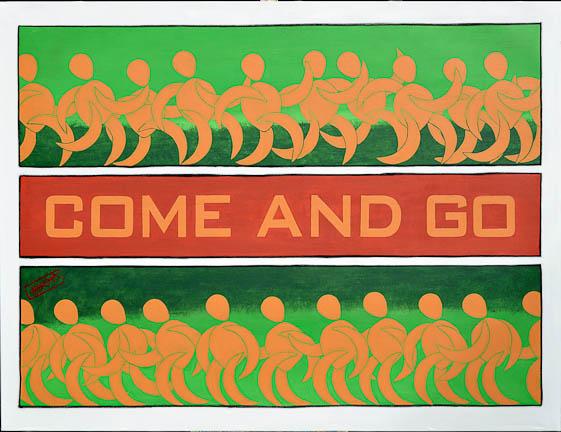
I use the glyph to mark thoughts, memories, life.
The glyph is an archetype in the Jungian sense, so it although individual expression may be recognizable by the collective.
Its shape is familiar, see the known and culturally integrated.
Outside of any aesthetic interpretation and distances itself from described.
Similarly, because of its neutral form, the glyph does not suggest interpretations on his being. Its recognition through the simple action representation. And 'that define it. The glyph is nice but without aesthetic contemplation, being not develop complacency or action, passion or feeling. The glyph is not interpreted but it is interpreted in a conceptual space of investigation and provides the observer with no pre-judgments detectors; as a puzzle to reveal proposes autonomous spaces of perception and reflection. I currently have privileged two aspects of the glyph: a distinctly artistic and free in his compositional anarchy, the sequential and linear other and joined by a code. Artistically, it highlights in the composition with glyphs, with the drawing sign, a figuration-representation of representation.
Then, in the drawing, I try to line effects, surface and matter that I consider necessary to complement the idea expressed.
In this idea there is a form that the glyph does not hide, indeed highlights and you see clearly, a core identity that the glyph used to interact with the elements. It is the figure of the organic body with his enjoyment and movement, his actions and report. In short, his drive, his rhythm, his being. The body is, because he lives, expresses and communicates.
- = + (Less is more). This is an affirmation of the twentieth century architectural elegance which explains the essence (poverty?). The glyph is born by subtraction but not become abstract. In the arts, sculpture, music or painting it is not to reproduce or invent forms, if anything, to perceive the forces. So no art is figurative, and really I think is also necessary to distance the figure from the figurative. Klee quote: "... do not make visible but make visible." The creation of a glyph as a sign, is the present moment and looks to the future through a narrative intention filtered visible. The sign of today, with its possible readings and interpretations, as will be read and interpreted tomorrow? Moreover, the narrative has its structural coherence, constructive linearity by a thought that processes streams of verbal representation that is writing and that many currents and artistic Tribe of the twentieth century, have made and continue to make their own painting. I think that the space between the written word and image can contain himself in infinitesimal scan a thought and I believe that writing with all its signs, alphabets or ideograms that are, on a creative level, and in theory, can offer itself as a fertile place for artistic research . Finally, do not forget that behind every write lurks the attempt / possibility of a universal representation and all with about twenty signs.
Einstein uses five of these signs and opened a door in the universe. Mozart with seven created a universe of music. We can say that the signs mark the way and that ... "primitive rock carvings, surrounded the promise of a Raphael or a Michelangelo" (Nitobe Inazo 1897). This is the strength of the sign / glyph.
Finally: use the glyph to paint what I write not as well as I write what I do not paint. This not to forget that a painting is a note, a thought, a reflection expressed on a single canvas occasionally notebook.
To get further information on the Glyphs see: www.monacoart.eu
I use the glyph to mark thoughts, memories, life.
The glyph is an archetype in the Jungian sense, so it although individual expression may be recognizable by the collective.
Its shape is familiar, see the known and culturally integrated.
Outside of any aesthetic interpretation and distances itself from described.
Similarly, because of its neutral form, the glyph does not suggest interpretations on his being. Its recognition through the simple action representation. And 'that define it. The glyph is nice but without aesthetic contemplation, being not develop complacency or action, passion or feeling. The glyph is not interpreted but it is interpreted in a conceptual space of investigation and provides the observer with no pre-judgments detectors; as a puzzle to reveal proposes autonomous spaces of perception and reflection. I currently have privileged two aspects of the glyph: a distinctly artistic and free in his compositional anarchy, the sequential and linear other and joined by a code. Artistically, it highlights in the composition with glyphs, with the drawing sign, a figuration-representation of representation.
Then, in the drawing, I try to line effects, surface and matter that I consider necessary to complement the idea expressed.
In this idea there is a form that the glyph does not hide, indeed highlights and you see clearly, a core identity that the glyph used to interact with the elements. It is the figure of the organic body with his enjoyment and movement, his actions and report. In short, his drive, his rhythm, his being. The body is, because he lives, expresses and communicates.
- = + (Less is more). This is an affirmation of the twentieth century architectural elegance which explains the essence (poverty?). The glyph is born by subtraction but not become abstract. In the arts, sculpture, music or painting it is not to reproduce or invent forms, if anything, to perceive the forces. So no art is figurative, and really I think is also necessary to distance the figure from the figurative. Klee quote: "... do not make visible but make visible." The creation of a glyph as a sign, is the present moment and looks to the future through a narrative intention filtered visible. The sign of today, with its possible readings and interpretations, as will be read and interpreted tomorrow? Moreover, the narrative has its structural coherence, constructive linearity by a thought that processes streams of verbal representation that is writing and that many currents and artistic Tribe of the twentieth century, have made and continue to make their own painting. I think that the space between the written word and image can contain himself in infinitesimal scan a thought and I believe that writing with all its signs, alphabets or ideograms that are, on a creative level, and in theory, can offer itself as a fertile place for artistic research . Finally, do not forget that behind every write lurks the attempt / possibility of a universal representation and all with about twenty signs.
Einstein uses five of these signs and opened a door in the universe. Mozart with seven created a universe of music. We can say that the signs mark the way and that ... "primitive rock carvings, surrounded the promise of a Raphael or a Michelangelo" (Nitobe Inazo 1897). This is the strength of the sign / glyph.
Finally: use the glyph to paint what I write not as well as I write what I do not paint. This not to forget that a painting is a note, a thought, a reflection expressed on a single canvas occasionally notebook.
To get further information on the Glyphs see: www.monacoart.eu







Comments 0
Say something