13 February 2016
If not explicitly requested by the collector, I do not sign my paintings on the front but on the back.
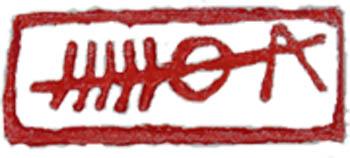
At the front, often I choose to sign using the footprints of two red seals made by me on stone. These seals are called "Tenkoku". To do this, I took inspiration from the Sino-Japanese culture, making an accurate identifying mark.
There is no causality in the red marks that are reproduced by their mark.
They represent my name, "Monaco", reconstructed according to a specific principle that has allowed me to rework the entire alphabet with interesting results in perspective.
In practice I have studied and invented two new alphabets writable, readable but not dicibili because they are not phonetic. I remember that in human history there have been no other alphabets dicibili. An example for all are the Egyptian hieroglyphics.
Of course, to read and understand my seals, you must know the code and the best thing would be to have a Rosetta Stone refers to these alphabets. In this regard, I remember that even the Glyphs are a particular extremely precise alphabet, so as to have, at least, by definition, dental, labial etc.
Returning to Tenkoku, its use is encoded in the history of Sino-Japanese culture, it is these are some records that explain the function.Traditionally, in the Japanese and Chinese painting and drawing it appears in the work including some brands of various shapes and red.
They have signatures, identification emblems artist, mottos or even short poems.
The artist shall engrave on stone or wood more seals of various shapes and sizes, with your name or nickname and use them as appropriate to identify or express thoughts and unique atmosphere.
The artist can place seals on the same work, grouping them in various positions around the signature or disjoint in order to affect the overall balance. In fact they come to do the work integral part thereof.
In the realization of these seals, the calligraphic style generally used is called Tensho, or "seal script", a particular style and very old, which today finds application and its almost exclusive feature in the seals.
The art of these seals, in Japanese is called Tenkoku and its presence is an integral and value the work of an artist. The Tenkoku is decisive for the balance of the composition and if not properly built and positioned, it becomes a nuisance endangering the harmony of the work.
The Tenkoku is itself a piece of art, in fact, some artists create works exclusively with these seals whose magnitude can vary from miniature also remarkable measures.
The Tenkoku are of two types: Shu-bun and are engraved in a positive (ie relief) and have red signs or Haka-bun and are engraved in negative (ie in recess) and have white markings.
The seals, from their origins, held several official and private functions, so as to have the value of a legal signature in Japan, but each of them, according to their form, also contains an aesthetic value.
The utilitarian and communicative functions of seals may be subdivided as follows:
- Indicate the name of the author or the copyright holder (personal and legal seals);
- Expressing phrases or propitiatory characters or protective;
- Communicate edifying content or feelings through quotes poetry or religious.
Alongside the seals bearing the typeface are those figured (especially animals), which generally functions to highlight the author's emblems, protecting from negative influences or arousing good wishes.
At the front, often I choose to sign using the footprints of two red seals made by me on stone. These seals are called "Tenkoku". To do this, I took inspiration from the Sino-Japanese culture, making an accurate identifying mark.
There is no causality in the red marks that are reproduced by their mark.
They represent my name, "Monaco", reconstructed according to a specific principle that has allowed me to rework the entire alphabet with interesting results in perspective.
In practice I have studied and invented two new alphabets writable, readable but not dicibili because they are not phonetic. I remember that in human history there have been no other alphabets dicibili. An example for all are the Egyptian hieroglyphics.
Of course, to read and understand my seals, you must know the code and the best thing would be to have a Rosetta Stone refers to these alphabets. In this regard, I remember that even the Glyphs are a particular extremely precise alphabet, so as to have, at least, by definition, dental, labial etc.
Returning to Tenkoku, its use is encoded in the history of Sino-Japanese culture, it is these are some records that explain the function.Traditionally, in the Japanese and Chinese painting and drawing it appears in the work including some brands of various shapes and red.
They have signatures, identification emblems artist, mottos or even short poems.
The artist shall engrave on stone or wood more seals of various shapes and sizes, with your name or nickname and use them as appropriate to identify or express thoughts and unique atmosphere.
The artist can place seals on the same work, grouping them in various positions around the signature or disjoint in order to affect the overall balance. In fact they come to do the work integral part thereof.
In the realization of these seals, the calligraphic style generally used is called Tensho, or "seal script", a particular style and very old, which today finds application and its almost exclusive feature in the seals.
The art of these seals, in Japanese is called Tenkoku and its presence is an integral and value the work of an artist. The Tenkoku is decisive for the balance of the composition and if not properly built and positioned, it becomes a nuisance endangering the harmony of the work.
The Tenkoku is itself a piece of art, in fact, some artists create works exclusively with these seals whose magnitude can vary from miniature also remarkable measures.
The Tenkoku are of two types: Shu-bun and are engraved in a positive (ie relief) and have red signs or Haka-bun and are engraved in negative (ie in recess) and have white markings.
The seals, from their origins, held several official and private functions, so as to have the value of a legal signature in Japan, but each of them, according to their form, also contains an aesthetic value.
The utilitarian and communicative functions of seals may be subdivided as follows:
- Indicate the name of the author or the copyright holder (personal and legal seals);
- Expressing phrases or propitiatory characters or protective;
- Communicate edifying content or feelings through quotes poetry or religious.
Alongside the seals bearing the typeface are those figured (especially animals), which generally functions to highlight the author's emblems, protecting from negative influences or arousing good wishes.





Comments 0
Say something