Interviews, Italy, Alessandria, Acqui Terme, 26 July 2014
Acqui Terme. We doubt it was done on purpose, but where there are no promoters of exhibitions at Palazzo Robellini (no councilor or alderman to welcome the guest: to be recorded, it is a sign ...) arrives, say Norberto Bobbio, "Mr. Case ".
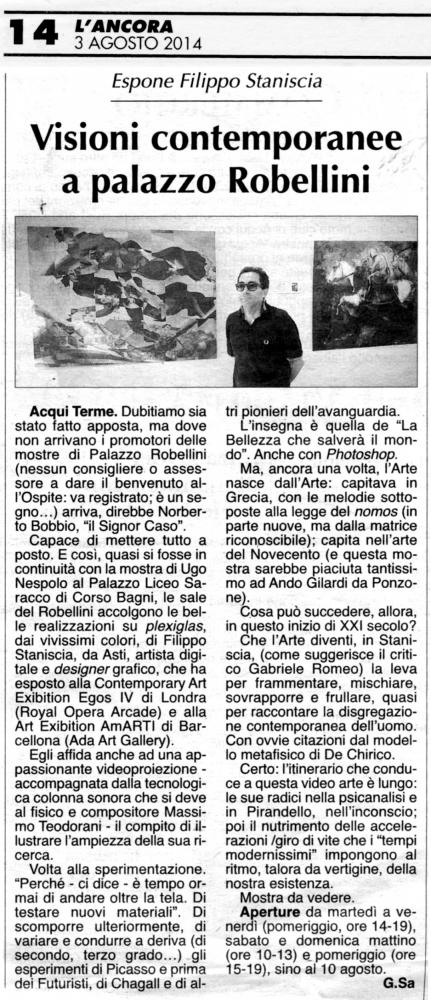
Able to put everything in place. And so, as if it were a continuation of the exhibition at the Palace of Hugh Medlar Saracco High School Course bathrooms, the halls of Robellini welcome the beautiful achievements of Plexiglas, the vivid colors of Philip Staniscia, from Asti, digital artist and graphic designer, who has exhibited at the Contemporary Art Exhibition Egos IV in London (Royal Opera Arcade) and the Exhibition love you in Barcelona (Ada Art Gallery).
He also relies on a fascinating projection-accompanied by technological soundtrack that is due to the physical and composer Massimo Teodorani - the task of illustrating the breadth of his research.
Once the trial. "Why - he says - it is now time to go beyond the canvas. Di test new materials." Decompose further, to vary and lead to drift (second, third grade ...) experiments of Picasso and before the Futurists, Chagall and other pioneers of the avant-garde.
The sign is that of "Beauty will save the world." Even with Photoshop.
But, once again, art is born from Art: it happened in Greece, with the melodies subject to the law of the nomos (partly new, but recognizable by the matrix); understood in the art of the twentieth century (and this dis-plays would be adored by Ando Gilardi Ponzo-tion).
What happens, then, at the beginning of the twenty-first century?
That art becomes, in Staniscia, (as suggested by the critic Gabriele Romeo) lever to fragment, mix, blend and overlap, as if to tell the disintegration of contemporary man. With obvious quotes from De Chirico's metaphysical model.
Of course: the route that leads to this video art is long: its roots in psychoanalysis and in Pirandello, unconscious; then the nourishment of the acceleration / crackdown that the "modern times" require the rhythm, sometimes vertigo, of our existence.
Show to see.
Able to put everything in place. And so, as if it were a continuation of the exhibition at the Palace of Hugh Medlar Saracco High School Course bathrooms, the halls of Robellini welcome the beautiful achievements of Plexiglas, the vivid colors of Philip Staniscia, from Asti, digital artist and graphic designer, who has exhibited at the Contemporary Art Exhibition Egos IV in London (Royal Opera Arcade) and the Exhibition love you in Barcelona (Ada Art Gallery).
He also relies on a fascinating projection-accompanied by technological soundtrack that is due to the physical and composer Massimo Teodorani - the task of illustrating the breadth of his research.
Once the trial. "Why - he says - it is now time to go beyond the canvas. Di test new materials." Decompose further, to vary and lead to drift (second, third grade ...) experiments of Picasso and before the Futurists, Chagall and other pioneers of the avant-garde.
The sign is that of "Beauty will save the world." Even with Photoshop.
But, once again, art is born from Art: it happened in Greece, with the melodies subject to the law of the nomos (partly new, but recognizable by the matrix); understood in the art of the twentieth century (and this dis-plays would be adored by Ando Gilardi Ponzo-tion).
What happens, then, at the beginning of the twenty-first century?
That art becomes, in Staniscia, (as suggested by the critic Gabriele Romeo) lever to fragment, mix, blend and overlap, as if to tell the disintegration of contemporary man. With obvious quotes from De Chirico's metaphysical model.
Of course: the route that leads to this video art is long: its roots in psychoanalysis and in Pirandello, unconscious; then the nourishment of the acceleration / crackdown that the "modern times" require the rhythm, sometimes vertigo, of our existence.
Show to see.





Comments 5
Lino
Say something